

How Many Restrooms Does a County Fair Need?
Start with the crowd curve, not the gate total. A fair that runs three days and draws 5,000 people a day behaves differently than a construction crew on site for a month, so the standard porta potty rental counts used for job sites do not translate directly. OSHA 1926.51(c) sets 1 toilet for 20 workers, scaling up to 1 seat and 1 urinal per 40 from there, and that ratio is still the sanest starting point for staff and vendor crews working the grounds in Sunrise. Attendees need more density than workers because they arrive in waves around gate times and headliner sets. Most fair organizers plan around one standard porta potty rental per 75 to 100 guests for a single day event, then add units near food courts and grandstands where lines build fastest. ADA Standards section 213.2 requires that at least 5 percent of any clustered bank of single-user units be accessible, with never fewer than one, so a dozen-unit cluster still needs an ADA accessible porta potty at minimum. Use the how many porta potties do I need guide to run your own headcount before you order.
What Restroom Options Work Best for a County Fair Layout?
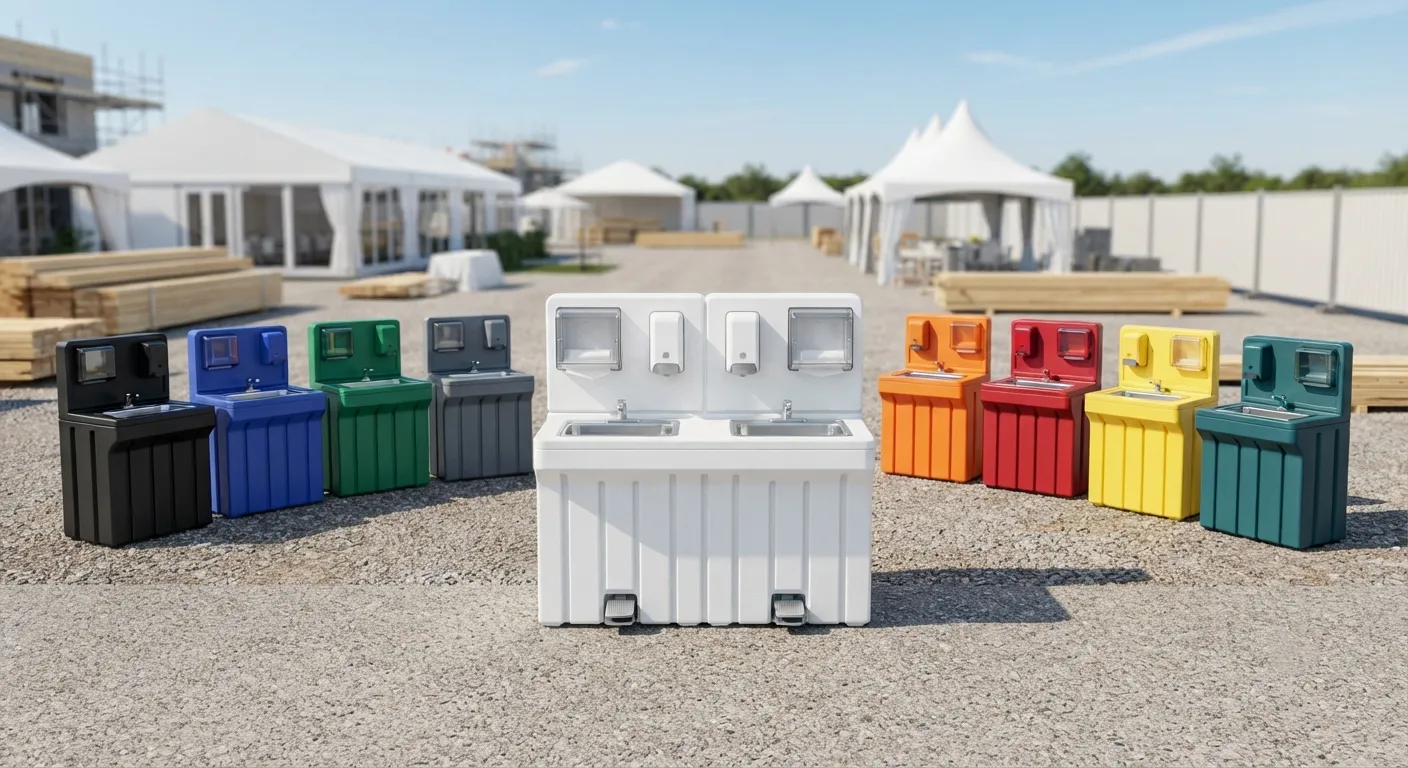
Fairgrounds are wide and foot traffic is uneven, so spreading units in clusters near stages, livestock barns and food rows beats one big bank by the entrance. A portable restroom rental fleet of standard units handles the volume, while a deluxe flushable porta potty or two near VIP seating or sponsor tents raises the experience without blowing the budget. For fairs with a longer run, a restroom trailer rental gives real sinks and flush toilets, and a 4 stall restroom trailer or 8 stall restroom trailer can anchor a main plaza while standard units cover the rest of the grounds. Each standard unit carries a 60 to 70 gallon holding tank and stands about 92 inches tall on a footprint near 44 by 48 inches, which matters when you are laying out placement between barns, rides and vendor rows. Add a handwashing station rental at every food vendor row; 29 CFR 1910.141(d)(2) requires soap and towels or a hand drying device at washing facilities, and hand sanitizer alone does not satisfy that. Fairs with livestock exhibits should also look at farm and agricultural restrooms guidance, since barn areas draw traffic patterns closer to agricultural work than to a typical festival crowd.
Do County Fairs Need Permits or Setback Rules for Restroom Placement?
Placement in the public right of way, along fair midways or near barns and access roads, needs confirming with the City of Sunrise before delivery day, since local placement rules were not verified for this page. Do not assume a setback distance without checking with the city first. Trucks delivering standard units and trailers need roughly 60 feet of straight clearance behind them to unload safely, which matters on fairgrounds with tight access lanes between rides and vendor rows. ADA Standards section 405.2 caps ramp slope at 1:12 for any trailer or accessible unit needing a ramp approach, and section 304.3.1 calls for a 60 inch turning circle at accessible units, both worth checking before the layout is finalized. Review the porta potty permit requirements page and the porta potty placement guide early, ideally when you are still sketching the site map. Fair organizers in Sunrise coordinating with vendors near Tamarac, 3.6 miles north, or drawing crowds from Lauderdale Lakes, 4.6 miles east, should build delivery windows with extra lead time, since multi-day fairs often need a mid-run service pass under the standard weekly interval baseline set by ANSI/PSAI Z4.3.
| unit | duration | low | typical | high |
|---|---|---|---|---|
| standard | event | 200 | 400 | 800 |
| ada | week | 120 | 185 | 240 |
| deluxe | week | 150 | 250 | 290 |
| trailer | event | 2499 | 3500 | 3899 |
Full breakdowns live on the restroom trailer rental cost and porta potty rental cost pages if you want to compare against a daily or weekly rental instead of an event rate.
How far in advance should we book county fair restrooms?
Book as soon as your fair dates and expected daily attendance are set, ideally 30 to 60 days out. Multi-day fairs need extra lead time to schedule service visits mid-run. Waiting until fair week limits your unit choices, especially for trailers and ADA units, which have smaller available fleets.
Can we mix standard units with a restroom trailer at one fair?
Yes, and it is common. Standard units cover general midway and barn traffic, while a trailer anchors a main plaza or VIP area. Check the luxury restroom trailer option if sponsors or a beer garden need a nicer restroom experience.
Do fairground restrooms need handwashing stations separate from the units?
Yes, especially near food vendors. 29 CFR 1910.141(d)(2) requires soap and towels or a hand drying device, which hand sanitizer does not satisfy. A portable sink rental at each food row covers this cleanly.
How many ADA units does a county fair restroom cluster need?
ADA Standards section 213.2 requires at least 5 percent of a clustered bank, never fewer than one. A 20-unit cluster needs at least one accessible unit; larger clusters scale up from there.
What happens if our fair runs longer than expected?
Service intervals can be adjusted mid-event, and additional units can often be delivered same day depending on fleet availability. Contact Sunrise Porta Pros or request a quote early if extension is a possibility.
Next step
Get a delivery date
Tell us the address, the dates and the headcount. We size the order and confirm the route.